Chapter IV
The Inner Discipline
The quiet fire that sustains the soul's journey
The Sacred Rhythm of Daily Practice
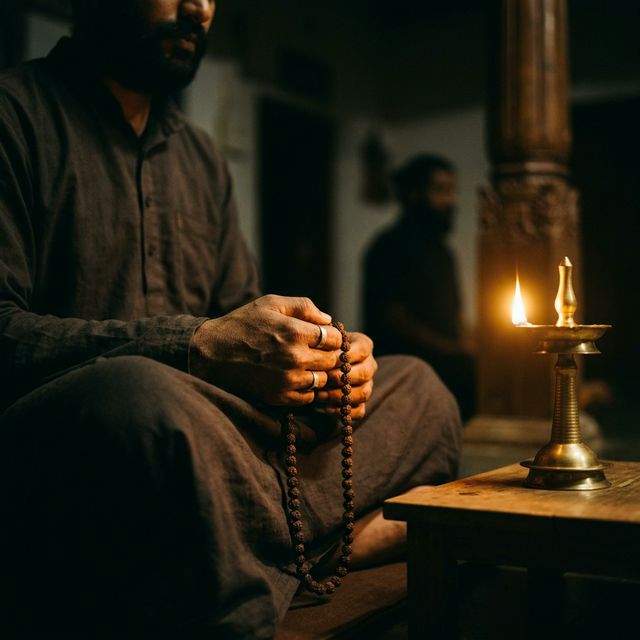
Long before the world stirs, when the darkness of night begins its reluctant surrender to the first whisper of dawn, Rajiv Lochan Dasa is already awake. This is the time of Brahma-muhurta — the sacred hour of God — and it is the foundation upon which his entire devotional life is built. At 4:00 a.m., while the world sleeps, the soul finds its most receptive state, and the chanting of the Hare Krishna Mahamantra fills the stillness with transcendent sound.
Sixteen rounds of japa mala each day — this is the commitment, and it is not a light one. Each round requires approximately seven minutes of concentrated chanting, each bead demanding full attention and sincere feeling. Over the years, Rajiv has learned that japa is not mere repetition; it is a conversation with the divine. Some mornings, the Names flow effortlessly, filling the heart with sweetness. Other mornings, the mind resists, and each mantra must be pulled from the depths of will and determination. Both experiences, he has come to understand, are equally valuable on the devotional path.
The discipline extends beyond chanting. Morning ablutions, attendance at mangala arati, study of the Srimad Bhagavatam, preparation for the day's service — each element is part of an integrated spiritual practice that leaves no gap for the mind to wander into territory that leads away from Krishna. This structure is not a cage but a garden — a carefully tended space where the delicate flower of devotion can grow without being choked by the weeds of distraction.
The Beauty of Voluntary Simplicity
In a world that celebrates excess, the path of voluntary simplicity is a radical act. Rajiv Lochan Dasa's life is marked by a deliberate turning away from the superfluous — not out of denial, but out of a deeper understanding of what truly nourishes the soul. Simple vegetarian prasadam, modest clothing, minimal possessions — these are not deprivations but liberations, freeing the consciousness from the constant demands of material maintenance.
The four regulative principles — no meat eating, no intoxication, no illicit connection, no gambling — form the ethical bedrock of his practice. Far from being restrictive, these principles create a clarity of mind and steadiness of character that enable deeper spiritual experience. Rajiv often explains to curious inquirers that these regulations are not about what one gives up, but about what one makes room for: clarity, peace, compassion, and a mind capable of sustained devotion.
"Austerity is not punishment for the body — it is a gift to the soul. When the senses are calm, the heart can hear Krishna's flute."
The Nectar of Scriptural Study
For Rajiv Lochan Dasa, the study of scripture is not an intellectual exercise but a devotional act. Each morning, as part of his daily sadhana, he immerses himself in the pages of the Srimad Bhagavatam, allowing the narrations of Krishna's pastimes to wash over his consciousness like the waves of a transcendental ocean. He reads slowly, carefully, often returning to the same passages multiple times, each reading revealing new layers of meaning and beauty.
He holds Srila Prabhupada's purports in particularly high regard. "The purports are where the Acharya opens the treasure chest," he often says. "The verses are the gems, but the purports show you how to wear them — how to integrate the wisdom into the fabric of your life." This combination of scholarly rigor and devotional warmth that characterizes Srila Prabhupada's commentaries has become the model for Rajiv's own approach to teaching and sharing knowledge.
"One who has unflinching devotion for the Supreme Lord and is directed by the spiritual master, in whom he has similarly unflinching faith, reveals the import of Vedic knowledge." — Svetasvatara Upanishad 6.23